Nine years after the fall of Smaug, travellers have returned to the old roads. So have rumours. This is the Company's story, told one played session at a time.
These were the latter days of the Third Age of Middle-earth, in the year two thousand nine hundred and fifty as the Wise reckoned it. The Hobbits of the Shire counted it otherwise, and would tell you so at some length; but it was the same year for all that, and it was winter, a few weeks after Yule.
Long ago, when the world was younger, there had been kings in the North. Men came out of the sea from a land that was no more, and raised a realm called Arnor. Its roads ran straight from the havens to the mountains, and from the watchtower upon Amon Sûl the eyes of the kings looked out over all the wide country between. But kingdoms, like households, may fall to quarrelling among the heirs. Arnor was parted into three, and the three were worn away, one by one, by a cold and cruel power that rose in Angmar beyond the northern hills.
It was nearly a thousand years since the last king of the North was lost, and Bree had managed without one ever since, more or less. Amon Sûl was a broken crown upon its hill, and grass had taken the stones of roads that once had kings to keep them. The great city of the north lay empty on its downs, and the people of Bree, who had forgotten its name, called it Deadmen’s Dike and did not go there.
The Shire still kept the laws of the old kings, chiefly because they were sensible ones, and tended its fields, and asked nothing of anybody. Bree, where the old roads met, tended its gates and its neighbours, not to mention its rumours. Big Folk and Little Folk lived there side by side, as they did nowhere else in the world, and each considered the arrangement chiefly to their own credit.
Beyond Bree’s gates Eriador was still a land of long distances. There were miles of heath where a traveller might see no chimney smoke before evening, and find no company but birds, creatures in the grass, and the occasional fish stirring a pond. Rangers crossed those miles: weather-stained men who came and went without explanation and seldom stayed to be thanked. Few who met them knew what they guarded, and fewer asked.
Far away in the East, things had gone better than anyone had dared to hope. Nine years before, the Dragon Smaug had fallen burning upon the town of the Lake, shot from the sky by a bowman of Esgaroth; and that bowman was now Bard, King in Dale. Dáin Ironfoot sat beneath the Lonely Mountain. The goblins of the Misty Mountains had been broken in the Battle of Five Armies, and the Wild had been quieter since than in many lives of Men. Bells rang again in Dale, and Erebor was waking.
The roads had felt it. Dwarves passed through Bree on the long way between the Lonely Mountain and the Blue Mountains, and traders walked beside their pack ponies. The pony yards heard the change in hooves, the inns in unfamiliar voices, and the smith in work that came before breakfast. “Six wagons since dawn,” an ostler would say; and the smith would answer, “Then tell the seventh to shoe its own ponies.”
Now and then, on a clear night, Elves passed along the East Road going west, singing, and did not stop. Bree-folk who saw them went home and said nothing about it until morning, when they said a great deal.
But the past is not so easily buried as kings. Sensible folk left the old places alone: the barrows on the downs, the cellars of the empty city, the diggings of Dwarves whose names nobody remembered. Nobody remembered why, either, which was perhaps the best reason of all.
Old threads ran beneath the new roads, from the past into the present, fine as spider-silk and as hard to see; and whoever walked those roads might find them catching at the sleeve.
At dusk on the twentieth of January the gatekeeper barred Bree’s south gate, and the sound of it carried up the lane to the Brockhouse yard. A thin cold rain had made the ground soft, and the guests coming in were wiping their boots on anything that would serve: the scraper by the door, the bottom rail of the fence, the edge of the water trough.
An old lettered stone propped one corner of the trough. The worn letters on it said SOUTH GATE, which had not been true for many years; Rufus Brockhouse had carried it home when the gate was mended, holding that good stone ought not to be wasted. He had tied a pony to it now, and was explaining to the animal, in a reasonable voice, that the supper table had not been laid for him.
“You had yours,” he said.
The pony reached farther.
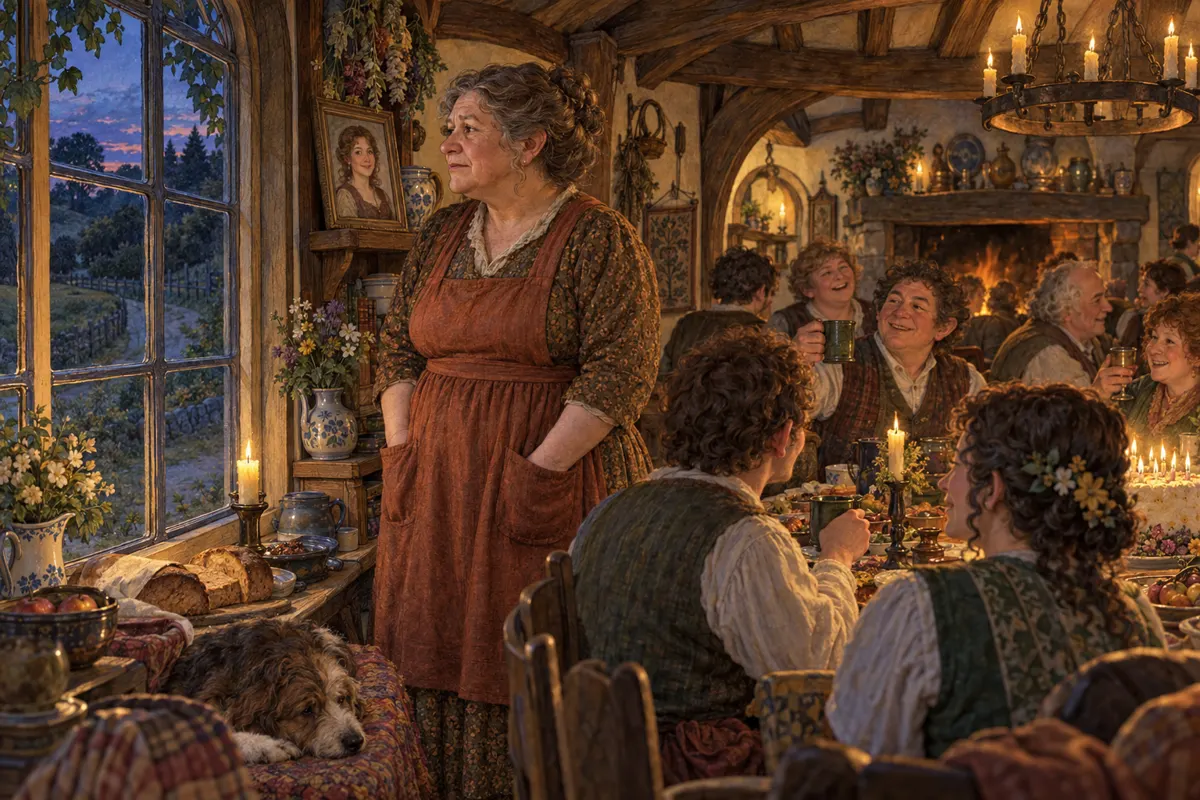
Lanterns hung between stable and house, and their light lay in long yellow pieces across the wet yard. Big Folk and Little Folk made room for one another along the boards, and Nora Brockhouse had found places even for the road guests: Farin, a Dwarf of the Blue Mountains whose pack pony was in Rufus’s stalls, and Halla of Dale, whose wagon of cloth had come west in his company. Farin had a bent harness buckle in his hands, and was frowning at it as though it had spoken ill of his kin.
“Leave it until morning,” said Halla. She took the buckle from him and put warm bread into his hands instead. Farin looked at the bread, and then at the buckle in her lap, and allowed that the bread was the more pressing matter.
Nell Banks had brought mushroom pies, and stood over them with the air of one who has counted every pie and means to count them again. Little Olo Proudfoot, who was four, had nonetheless got within reach of the nearest when his father caught him gently by the collar. Odo Proudfoot had come in from the Shire that afternoon with a pony for Rufus, and had stayed, as people did, for supper.
“After supper,” said Odo.
“But after supper they’ll be gone,” said Olo.
Somebody at the far end of the board called to the Proudfoots to come and sit down before the bread went cold. “Proudfeet, if you please,” said Odo mildly, steering his son towards the bench. “One foot, two feet. One Proudfoot, two Proudfeet.”
By the stable wall Hugh Mugwort, the Bree-man whose wheels kept the Brockhouse carts on the road, had leaned a mended cartwheel and taken up a mug in its place. Tobin Tunnelly, a carter from Staddle, had a tale of the road for him, and Hugh was hearing it out with a wheelwright’s patience.
“Last time it was only one wheel,” said Hugh.
“That was before the rain,” said Tobin.
“Supper’s ready,” Nora called across the yard. “You can argue over the wheel at the table.”
It was Wilcome Brockhouse’s birthday. He was three-and-thirty that day, and so come of age as Hobbits reckon it; and since it is the custom of Hobbits to give presents rather than to receive them on their own birthdays, Wil had been keeping the custom with a thoroughness that made his parents exchange looks. The things he meant to give away were piled on a trestle board beside the house door, and they were a good many. Someone had fetched a cask from the Prancing Pony, and for once in that yard the smell of warm bread was stronger than the smell of hay.
Among the guests was a young Man of Dale, Nilbog son of Llort: tall, brown-haired and browner with weather, with a sword at his side, a glint of mail at his collar, and a cloak that had seen a good deal of road. He had ridden guard on Brockhouse carts more than once, and had hired them more than once besides, and he had his place on the bench with the rest.
Wil came to him with something from the trestle held in both arms. It was a sturdy cooking pot with a close-fitting lid, and a handle worn smooth with use.
“This came from my mother,” said Wil, and set it in Nilbog’s hands. “It always cooks good food. Whatever goes into it comes out good.”
Nilbog turned the pot about, and lifted the lid, and looked inside, as though some of the good food might be in there already.
“I’ll never cook as well as your mother,” he said.
Nora, going by with a dish, heard that. She went on with the dish; but she looked pleased.
Supper went forward. There were Nell’s pies, and Olo had one in the end; there was bread, and a ham, and talk enough to fill the yard twice over: the road, the rain, the price of feed, and Farin’s buckle, which everyone had forgotten except Farin. Only one place at the long board stayed empty, and the plate beside it stayed clean.
It was Tansy’s place. She was Wil’s younger sister, nine-and-twenty and not yet of age, though she had worked the family’s roads since she was old enough to hold a lead-rein, and kept the road book in a hand as neat as her mother’s. On the eleventh of the month she had gone south-east with Bramble, carrying Dwarf-House stores to the camp in the downs, where the spring flood had torn open a hillside and laid bare an old arch, and Dwarves had come to dig. That run had first been offered to Wil. He had turned it down, meaning to be gone on a road of his own before long, and Tansy had taken it in his place; and she had promised to be home for his birthday.
Nora held Tansy’s plate a moment before she set it aside.
“Tansy said she’d be back for your birthday,” she said. “Leave her the good piece.” She glanced along the trestle, where the heap of Wil’s giving had grown a great deal smaller since noon. “She’d call you Mister Baggins for giving away half the yard.”
Wil laughed, for it was exactly what Tansy would have said, and he could hear her saying it.
Rufus did not laugh. He was looking down the lane again, as he had been doing all evening between one errand and the next. Then he came and sat down at the table.
It was full dark when hoofbeats came up the lane. There was only one pony, and the beat of it was wrong: quick and then slow and then quick again, as if the animal could no longer keep its own time. The talk stopped at the near end of the board, and then along the rest of it.
It was Bramble who came home.
She came into the lantern light alone, foam on her neck and a loose strap knocking against her side. Pale threads clung to her harness. She went straight past the tethered pony to the water trough and stood there with her head down, trembling.
Rufus was beside her before anyone else had risen. He put a hand on her neck.
“Easy, Bramble.” Then he looked past her, down the empty lane, where the rain was coming down in the dark.
Nora had turned from the place she kept for Tansy. “Where is she?”
No one answered her. Bramble drank.
Wil and Nilbog came to the trough, and Rufus held the pony’s head while they looked her over. “She’s near spent,” he said. “Water first. Look all you like, but let her drink.”
There was mud on her legs to the hocks, pale and caked, and there were fresh scratches along her flanks and shoulders. The strap that knocked against her side was broken, its end hanging loose. And there were the threads. They clung to the harness and the buckles and the broken strap: pale, and finer than anything in Nora’s workbasket, and unwilling to let go of what they had caught.
Wil had sat by old Mr Bilbo Baggins’s fire on visits to the Shire, and had heard about the spiders of Mirkwood more than once, with gestures. These threads looked very like the ones in those stories. He did not care for the resemblance at all.
The yard had been trampled by a whole birthday’s worth of guests, but the lane beyond it had not. Wil took a lantern down from its hook, and Nilbog went down the lane ahead of him after Bramble’s tracks, bending low and telling him where to hold the light.
Nilbog was an experienced hunter, and he read the wet ground the way Rufus read a pony: quickly, and without wasting words. The tracks were deep and uneven, close together where she had stumbled, and they ran in a straight line, as a pony’s will when it is going home and knows the way. No other marks went with them; nobody had walked or ridden beside her. He followed them down to the East Road and along it to the south gate, which had been barred at dusk and opened again for her; and beyond the gate, at the edge of the lantern light, he showed Wil where they came up out of the south-east.
Nilbog straightened and looked that way into the dark. “South-east,” he said. “The way she went.”
Wil held the lantern a little higher, as though that might help. The rain went on falling through its light.
While supper went forward in the Brockhouse yard, another traveller sat in the common room of the Prancing Pony, a little farther along the East Road.
The fire snapped under a low cloud of pipe-smoke. Mugs knocked against the tables, and now and then a burst of laughter rose above the talk and fell back into it. Men and Hobbits and travelling Dwarves made room for one another on the benches, shifting knees and mugs whenever someone needed to pass, and the talk carried on across three tables at once.
The traveller was tall, and kept his hood up indoors, which in Bree was thought a little odd, though not unheard of. What could be seen of his face beneath it was young and grave; it was the gravity that people remembered afterwards. His cloak was dark grey and closely woven, with a border worked along its edge in a pattern that turned back upon itself, and he wore gloves of soft brown leather, and kept a satchel by him on the bench.
Barnabas Butterbur came between the tables with a jug in one hand and a cloth in the other. His greying beard lifted with his smile.
“A place by the fire, sir? There’s food yet, and the ale’s our own. Tell me what you need.”
What the hooded guest needed, it appeared, was a seat, his supper, and the news of the road; and of those three the Pony always had plenty, the third most of all.
The name came up between the tables, as it did most evenings that winter: the Hope of the West. Barnabas paused with his jug.
“They say he cleared a path near the Ettenmoors last autumn,” he said. “Then, early this winter, a man led families safely home beneath the White Mountains. Some say it’s the same fellow. That is a fair stretch of road.”
He rested the jug against his apron. “Royal blood, too, if you believe all the telling. Though nobody seems able to give him a name. Still, folk are pleased to hear of someone getting people home.”
At the next table sat an older traveller in practical clothes and a weathered grey cloak, with papers spread before him. His long silver hair and beard caught the firelight, and a leather case stood beside his chair. He straightened a sheet while Barnabas made his way past, and looked up, and found the hooded guest looking at him; and he smiled, as a man does who has been alone with figures for longer than he meant to be.
The stranger spoke to him presently, and the old man made room.
“Master Ulfar,” he said. “I settle debts, estates and contracts for merchants from the east: a dull trade to describe, and a useful one to have. What name may I use for you?”
“Daerahil.”
Ulfar repeated it courteously, and considered him a moment longer than courtesy required. “You will forgive an old man’s curiosity,” he said. “You have an unusual look about you. Something out of the old songs. Númenórean, they would have called it, in the days when there were Númenóreans to call it anything.” He laughed a little at himself. “But I have spent too long among ledgers. Everything that is not a ledger begins to look like a song.”
They talked a long while after that, as travellers will who have found someone worth the talking: of the roads east and west, of Dale rebuilt and the Mountain reopened, of the lands that lay about Bree and the news each of them had gathered on the way. It was Daerahil who turned the talk at last towards darker things.
“There are some who say a shadow is growing in the world again,” he said. “And there is this Hope of the West, whom everyone in this room seems to know of and nobody has met. Is he one man, do you think, or a company?”
“I could not tell you that,” said Ulfar. “I am not certain there is anyone to tell you of. A road is cleared here, a family comes safely home there, and before long every fortunate turn has acquired the same pair of boots. Most of what I hear in inns is coincidence with a good storyteller attached.”
He laid his hand flat on the papers before him. “As for shadows, I can only tell you what passes across my table. Every season more merchants come over the mountains from the east than came the season before. Men do not carry their goods over the passes if they expect to lose them on the far side. Whatever the sky may be doing, the roads are getting safer.”
The door opened then on wet air and a gust of rain, and on one of the guests from the Brockhouse supper, his hat dripping. He came to the bar and spoke to Barnabas in the voice of a man who has carried news down a dark road and wants to be rid of it.
“The Brockhouses’ pony came home without Tansy. Her family is looking for help.”
The talk at the nearer tables faltered. Someone asked whether the lass had been thrown; someone else began to say what folk always said about old diggings, and was hushed. Barnabas set down his jug.
Ulfar had put down his papers.
“She is very dear to me,” he said quietly. “If her pony has come home without her, I fear she may need help.” He turned to Daerahil. “Would you speak with her family, and help them find her? I can spare coin more readily than winter travel. Whatever the search costs, in the ordinary way, I will meet myself.”
Daerahil shook his head. “Keep your coin, Master Ulfar. I came into Bree for news, and you have given me more of it tonight than I had any right to ask. Our conversation has been payment enough.”
Ulfar inclined his head. “Then I am doubly in your debt,” he said. “The Brockhouses keep the pony yard just off the East Road. You will know it by the lanterns.”
* * *
The rain had thickened when Daerahil went out. The East Road shone under the lamps of the Pony, and beyond their reach it was only a darker darkness with water running in it. He had not gone far when a light came bobbing up towards him from the direction of the south gate: a lantern, carried low, and two figures behind it, one tall and one not much higher than the tall one’s belt.
The lantern was lifted. Beneath it was a Hobbit’s face, round and wet and anxious.
“Your pardon,” said the Hobbit. “You haven’t seen a young Hobbit-lass on the road tonight, have you? Anywhere this side of the gate?”
“I have not,” said Daerahil. “But if you mean Tansy Brockhouse, I am looking for her as well. I was on my way to her family.”
The Hobbit stared up at him. “I’m her family,” he said. “Her brother. Wil Brockhouse.” Then, as though it had only just come back to him: “It’s my birthday.”
“Nilbog, son of Llort,” said the tall one at his side, a Man in a brown cloak with the rain running off his hood. He looked the stranger over, hood and gloves and all, as a man looks over a road he has not travelled before.
“Daerahil,” said the stranger. “What do you know of where she went?”
“South-east,” said Wil. “To the Dwarves who are digging in the downs, where the flood opened the hill. She took their stores on the eleventh, and she promised to be home tonight.”
“Her pony came in from the south-east,” said Nilbog. “Alone. I followed the marks as far as the gate.”
Daerahil was silent a moment, looking past them into the dark beyond the gate. “Then we are bound the same way,” he said.
So it was settled, there in the wet street with the rain coming down between them: the three would look for her together.
In the Brockhouse yard the trestle board that had held Wil’s birthday giving became a place for road supplies. Nora set out bread and dried fruit, and stood by to see what else could be carried, and fed everyone who came within reach of her, the tall stranger included, as though he had been one of her own.
Bramble stayed behind. She stood in her stall with a blanket over her back, and Rufus went to look at her more often than he needed to.
When all was ready, Rufus looked at them one after another, the way he looked over a team before a long haul.
“Bring Tansy home,” he said. “And come home yourselves.”
Nora looked from one to the next. “Send word when you can. Even a little word is better than all this waiting.”
The lanterns moved a little in the wind. Beyond the yard entrance the lane led back to the East Road.
* * *
On the far side of Bree-hill, Staddle gathered close against the slope: stone houses standing beside round Hobbit doors set into the hill, and small gardens between them and the track, bare and brown with winter. Smoke hung above the chimneys. Beyond the last houses Nilbog found Bramble’s trail again on the carrying track, coming in from the open country, and the three went out along it.
Staddle’s last roofs fell behind them. The track ran on through winter grass, with the village smoke thinning at their backs. The wind bent the dry stems all one way. In the hollows the ground stayed soft; on the higher stretches it was firmer, and there was little sound but the wind and their own going.
Then the land began to change. The ground folded into longer slopes, and grey stone showed through the thin grass, and each bare rise hid the next. Bree-hill sank behind them and was gone. The track still led on, worn by the carts of many years, but there were no roofs now, and no voices but their own.
From the top of one long rise they could see a great way. The downs went on into the south and east, fold behind fold, grey-green and dun under a pale sky, with here and there a darker line where thorn grew along a stream-bed; and the track went down before them and up the next slope like a pale thread laid across the land. Of Bree there was nothing left but a blue smudge in the north-west, which might have been the hill or might have been cloud.
Wil had lived all his life beside a road that went everywhere, and had watched it carry other people away. Now it was carrying him. He found, a little to his surprise, that he was glad to be on it, even on such an errand; and then he thought of the errand, and walked faster.
Nilbog went first all the way, reading Bramble’s trail wherever the ground had kept it: a hoofprint in the soft bottom of a hollow, a scuffed turf on a slope, once a few hairs from her tail caught on a thorn. They camped where the land gave them shelter, and went on in the grey mornings, and the days were short. On the last evening before the rain they came up a long slope as the light was going, and saw, far off among the folds of the downs, a thin thread of smoke standing up into the still air; and later, when the light had gone, a spark at the foot of it that did not move. It could only be the Dwarves’ camp. There was no reaching it that night, and they made their own camp in a hollow out of the wind.
Nilbog cooked supper in the pot. It was good. Wil said so, after the first spoonful.
“There,” he said. “What did I tell you?”
“That’s the pot,” said Nilbog. “Not me.”
* * *
In the morning the wind had gone round into the west. Cloud came over the downs low and grey, and before long a thin rain was falling.
A few steps from the track, a ewe stood caught in a tangle of thorns. Each time she tried to turn, the wool at her flank pulled tight. She had made a poor bargain with the hedge: the more she struggled, the faster it held her.
A shepherd in a thick coat had one hand against her shoulder and a knife ready in the other. He stopped cutting as he looked towards the track. The ewe gave a short, impatient bleat.
“Could you hold her a moment?” he called. “Two more have strayed.”
It took four of them, three to hold and one to cut, and rather less time than the ewe’s opinion of the business suggested. When she was free she trotted a few yards off, shook herself, and began to graze as though nothing whatever had happened.
The shepherd wiped his knife on his coat and looked out over the empty slopes. “There’s the two others somewhere,” he said. “Strayed since last night. I’d be glad of more eyes, if you’ve the time to spare.”
They told him about the missing Hobbit, and the camp beyond the hills, and that they must go on.
The shepherd nodded slowly, and did not hold it against them. “Then go on, and luck to your finding,” he said. “And if ever you come to Staddle, you’ll have a friend at my fold.”
They left him to his flock. For a while they could hear him behind them, calling to his sheep across the hillside; then the rain thickened, and they heard nothing more.
It grew heavier as the day went on. It came driving out of the west in long grey sheets, and the last rise before them disappeared behind a curtain of it. Water began to run along the carrying track and to stream from cloaks and packs, and the downs went dim on every side.
The carrying track ended at a timber barricade below an arch that last spring’s flood had laid bare. The hillside had broken away around it, and the old stone stood out of the raw earth like a door left standing in a fallen wall. Three new graves lay beyond the watch-fire. Axes were close to hand, but no one lifted one as the travellers came up. Rain drummed on the timber, and a shallow gutter cut in the stone carried water out from the arch and down the slope, hissing over the grit.
From the arch came the scrape of a loaded handcart and two Dwarves’ voices.
“A pony would make this easier.”
“We have none here. Push.”
A guard stood at the bar with the rain dripping from his hood. “Names,” he said. “Whom do you seek?”
Wil gave his own name, and Tansy’s, and said that he was her brother.
Something changed in the guard’s face at the name. “Wait at the bar,” he said. “I’ll call him.”
The Dwarf who came was broad and solid, with a long brown beard and a heavy leather work apron over dark clothes. Rain had darkened his shoulders and caught in his beard. He kept his eyes on whoever was speaking, and waited for the name and the business before he answered; and when he had them, grief and anger came into his face together, and it would have been hard to say which was uppermost. This was Dólin, who had charge of the camp.
“Tansy Brockhouse,” he said. “By the beard of Durin, your sister was spying through our halls.”
He did not wait for an answer. “Dáin himself told me of the Doom below. Dáin himself. She was to bring the goods and go on her way. She went where she was forbidden. She could have doomed us all.”
For a moment nobody said anything. Behind the watch-fire the three graves lay dark under the rain.
The travellers had not come to quarrel with him over where Tansy had or had not been, they told him; they had come to find her. If she was anywhere under that hill, they meant to bring her out.
Dólin heard them through. He looked at each of them in turn, and at the arch, and longest at the graves.
“I have folk missing too,” he said at last. He stopped, and when he went on his voice was rougher. “My father is one of them.”
The rain ran off the timber between them.
“You may go in,” said Dólin. “One group, with my escort. Keep together. And you will look for my folk as you look for her. That is my price.”
They agreed to it.
He called two of his Dwarves from the fire: Luki, who took up a lamp without being told, and another in a red shirt.
* * *
They passed beneath the arch, and the rain fell away behind them.
The stone of it was grey and finely joined, and older than anything in Bree. Inside, a short haulway ran back into the hill, with rails laid along its floor for the handcarts, and beside the rails ran the shallow channel they had seen outside, carrying the water down and out. The noise of the rain dwindled to a mutter at their backs. Luki’s lamp went before them, and their footsteps came back to them from the walls.
They were hardly inside when Daerahil stopped and lifted his head. “Water,” he said. “Somewhere ahead of us, and more of it than this channel carries.” Wil listened, and heard nothing but the mutter of the rain at their backs and the small sound of the channel at his feet; but Daerahil stood a moment longer, listening, before he went on.
There, just inside, a shallow alcove opened on the left, and in it stood a survey desk. Damp work sheets lay on it beneath stone weights.
“Dólin’s papers,” said Luki. “The day’s work, and the count of the hands.”
They read them by the lamp, while the escort waited. One was a tally of quarry hands and carriers, signed by Dólin, with the hired Men of Bree named at the head of it and Corin Hather set down as their foreman. Below came the loads received, and among them Tansy’s, on the fourteenth. Below that, under a heading that said After the Breach, a few short lines recorded what had become of the hands: one had been recovered dead, and Corin Hather had not returned.
The other was a single leaf headed Upper Workings, dated the sixteenth, which set down each of the four ways in a few short lines. To the west lay the old seam, sealed, and no pick was to strike it. To the north were dry upper rooms, and then fallen stone. To the east were an old sorting floor and a cold forge, where the spare lamps were kept. Of the north-west it said more than of the rest. There was a fall there, before a counting room; a feed sack for a pony had been caught in the fall; small boot tracks ran through the gap, where no Dwarf with tools could follow them, and the same tracks came back out.
That was what decided them. A feed sack for a pony, where the Dwarves kept none; small boots, going where no Dwarf could follow; and Tansy had come to this camp with Bramble.
Beyond the desk the rails divided. Four ways went off into the dark from the junction, each turning out of sight round its own bend, and along the floor the water ran in its channel towards the arch.
The north-west way climbed. The floor rose under their feet and the walls drew in, and the sound of water, which Daerahil had heard from the arch and the others had scarcely heard at all, grew louder as they went, until it filled the passage before them.
Here the water was rising.
Beyond a bend the passage opened on one side into a low recess, and the water was spilling into it. The floor of the recess lay below the gallery, a basin of stone, and Luki’s lamp showed water in it, dark and moving, fed by trickles that ran down out of cracks in the rock above. At the near edge a broad lip of stone stood clear of the flood. Beyond it a great slab had fallen and lay tilted, its upper end against the wall and its lower end down in the water.
Tansy lay upon the slab.
She lay on its upper part, above the water, on her side, with one arm under her head; and she looked as though someone had laid her there to keep her safe.
Below her, half under the lower end of the stone, a Man lay in the water. His leg was pinned beneath the slab, and the water stood at his chest. His head was tipped back against the rock, his face was grey, and his eyes were shut.
Neither of them stirred.
Wil said his sister’s name. She did not answer; but he could see her breathing. The Man in the water was breathing too, shallowly, and the water lifted a little against his chest at every breath.
Luki held the lamp out over the basin. “Hather,” he said. “The foreman. He never came back.”
There were marks on the slab. Someone had cut them deep into its face, in straight strokes set in lines, and the lamplight filled them with shadow, so that they stood out black upon the wet grey stone.
And from somewhere deeper in the hill there came a draught: not the damp chill of the passage, but a cold like the bottom of a winter well, and with it a smell, foul and close, that made the Dwarf in the red shirt put his sleeve across his face.
They brought Tansy down first. It was quickly done, for she lay above the water and weighed very little, and in a few moments they had her off the stone and on the dry lip beside them. Wil wrapped her in his own cloak and said her name again. She did not answer, and she did not wake.
Then they turned to Hather. Luki set his lamp down on the lip to light the work, and they knelt beside it and talked it over, with the water loud beneath them.
“It’s the low end that has him,” said Nilbog. “Where it’s down in the water, on his leg.”
“Then that is the end we must raise,” said Daerahil.
“Raise it how?” said Wil. “It must weigh as much as a loaded cart.”
Nilbog was already looking up at the rock above the basin. “Rope,” he said. “And a pulley, if I can make it hold.”
He set about it at once. He made a rope fast about the slab’s lower end, which meant going down into the cold water to his waist, and ran it up through a pulley that he lashed to a knob of rock overhead, and back down again to where they could all lay hold of it. He worked quickly and without talking, as a man works who has rigged loads before, and the water followed him up the stone as he climbed out.
Wil, meanwhile, looked the whole matter over once more, carefully, from the lip of the stone: the slab, the rope, the Man beneath, the trickles feeding in from the cracks above.
“The water is getting higher,” he said.
“It is,” said Nilbog, and went on with his knot.
It was. While they talked it had crept from Hather’s chest to his collarbone; now it lapped at the hollow of his throat, and each trickle from the cracks above came down a little faster than the last, as if the hill itself were in a hurry.
They laid hold of the rope, all three, and heaved. It came taut with a crack and sang in the pulley, and the stone answered: it ground, and shuddered, and its lower end lifted out of the flood, a hand’s breadth and then more, with the water pouring from it in sheets. The marked face of the slab rose into the lamplight.
Luki saw it rise, and his face changed. “Dólin must hear of this,” he said; and he was gone down the passage at a run, with the Dwarf in the red shirt hard behind him, and their footsteps went away into the dark.
The three did not look round. The slab hung groaning on the rope, but Hather’s leg was still caught beneath it, and the water was at his chin. It touched his lips. His head rolled a little against the rock, and the water followed it.
Nilbog set his feet against the stone and looked along the line at Daerahil.
“Take heart,” he said. “We need your strength with ours. All of it. Together, now!”
They heaved again, all three, with everything they had. The rope cracked in the pulley; the slab reared up out of the basin with the flood streaming off it; and Hather’s leg came free. Nilbog threw a turn of the rope about the rock and made it fast, and the pulley held; and they were down in the basin, all three, with the water to Wil’s chest, and had Hather by the arms and the collar, and drew him out from under the stone just as the water closed over his mouth, and up on to the lip beside Tansy, streaming and grey and alive. He breathed; he did not wake.
Then they took up their two burdens and went back down the north-west way, past the junction and the desk, and out beneath the arch into the rain.
They carried Tansy and Hather home by the way they had come. The going was slow, for neither could do anything to help themselves, and the downs, which had seemed so wide on the way out, seemed wider on the way back. The rain went off at last into the east, and a cold wind came after it and dried the track.
At night Wil sat by his sister and talked to her, as he would have talked to a frightened pony: about nothing much. He told her about the party, and Nell Banks standing guard over her pies, and how Olo Proudfoot had got one in the end; about Farin’s buckle; about the good piece their mother had kept back for her. Tansy slept on, and so did the Man beside her. On the other side of the fire Daerahil sat up with the stars, and Nilbog saw to the pot.
On the last day Bree-hill rose out of the north-west, first as a smudge, then as a hill with smoke above it. Staddle’s roofs came up before them, and then the road, and then the gate.
It was morning on the twenty-sixth of January when they came back into Bree, five days and a half since the gate had been barred on the evening of Wil’s birthday.
Morning had brought Bree back to its ordinary business. Doors stood open along the street, and voices carried between them: a greeting called across the way, a question about a delivery, an argument over something that must have seemed important before breakfast. Woodsmoke hung above the roofs. From the Prancing Pony came the smell of bread and the sound of crockery being gathered.
The inn’s yard was already busy. An ostler was working a brush through a pony’s coat while its owner checked the fastenings on a pack. Beside the passage a woman shifted a basket against her hip to let a pair of travellers by. Somewhere inside, someone was calling for another pot of hot water.
Then the people nearest the entrance saw Tansy and Hather.
The woman lowered her basket. A guest stepped back against the wall, drawing his belongings out of the way. The ostler set down his brush. Questions began, but quietly, and one of the servants turned towards the house before anyone had finished asking them.
Beyond the doorway the common room was warm with what was left of the breakfast fire. A few guests still sat over their cups. One had spread a road map beside his plate; another was carefully wrapping the food he had saved for later. Their talk faltered as they looked towards the door, and a chair scraped back to make room.
Barnabas Butterbur came out of the passage with a cloth in his hands. He looked first at the two who were carried, and then at the faces around them, and his usual welcome gave way to a more practical attention. He took a stool from beside the doorway and set it against the wall.
“Give them room there,” he told the nearest guests.
Someone began to ask what had happened. Butterbur lifted a hand.
“In a moment.”
He turned back to the travellers. Behind him the breakfast business went on in quieter voices.
“Now, then,” said Butterbur. “Tell me what you need.”
Erebor and Dale are rebuilding. Dwarves, merchants, and their pack ponies pass through Bree, bringing work and news from the east. Beyond the settled places, the North is still a country of long roads, scattered homes, and ruins whose names few remember.
Stories of a wandering rescuer called the Hope of the West have made some people look toward those roads with fresh courage. Others remember why the Rangers keep watch. No one in Bree can say what the Company will find.
The Company · three heroes
Wilcome “Wil” Brockhouse
A Bree-hobbit raised among the Brockhouse carts and ponies. At thirty-three, Wil is ready to leave the East Road behind and see the wider world he has heard about all his life.
Nilbog, son of Llort
A Barding of twenty-seven. After growing up in his twin brother's shadow, Nilbog seeks adventures that will earn him a name of his own. He has both protected the Brockhouse family and used their services.
Daerahil
A hooded Man with a young face and knowledge that sometimes seems older than his appearance. Daerahil travels through the lands of Men, seeking information about the growing darkness.